May Day Black Blocs and a Car Bombing
:Spring comes to Portland, Oregon

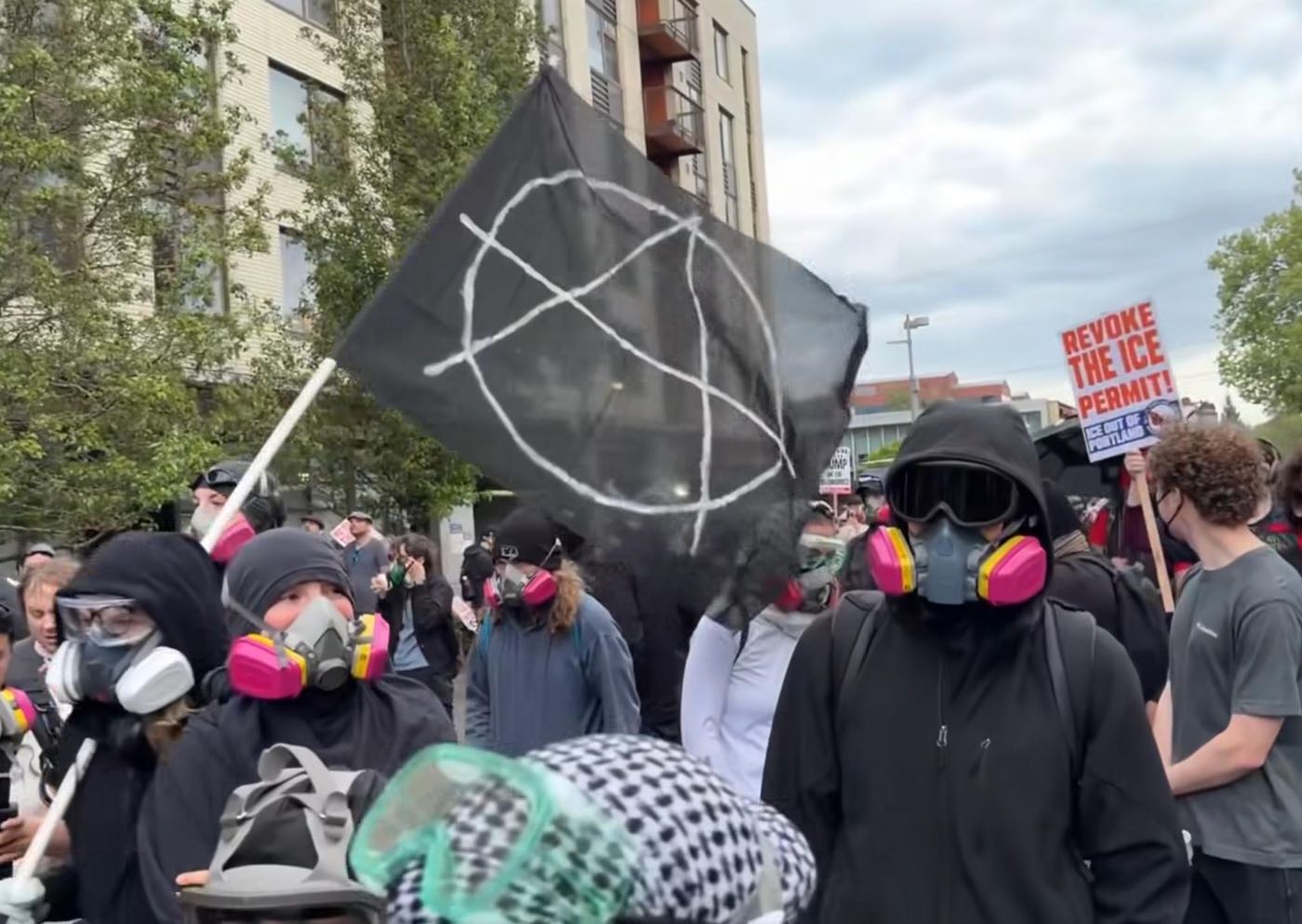
On May Day, anarchists in Portland participated in two black blocs, adding a confrontational edge to public protests. As anger against the economy and the government spreads alongside desperation and despair, it’s up to us to create opportunities for collective action.
Anarchists organized various events in the lead-up to May Day in Portland, Oregon. On May Day’s eve, we held a ritual for the anarchist dead, mourning both friends and forebears. Such practices are important not just to facilitate emotional processing, but also as means of torch-carrying and world-making.
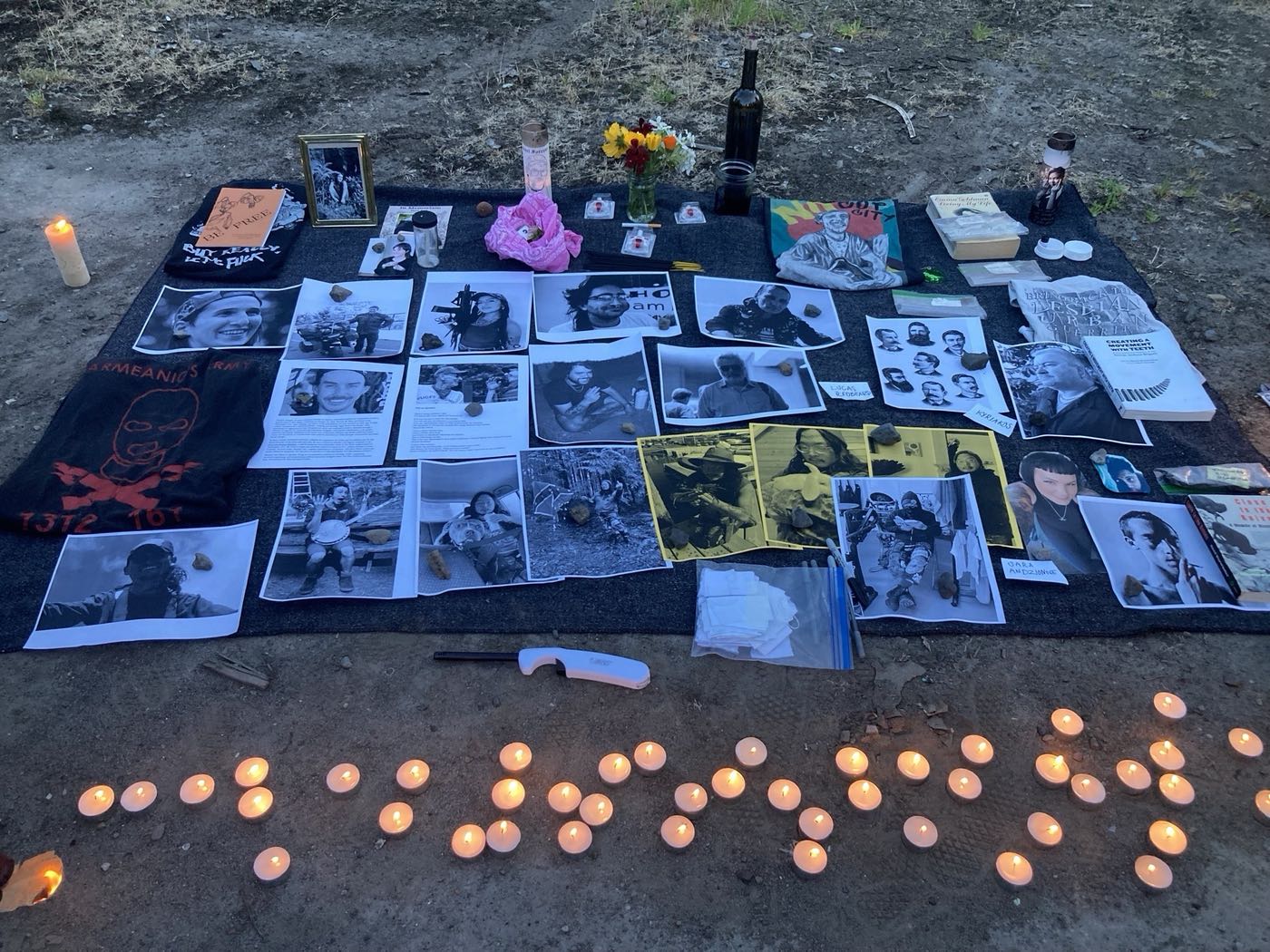
If that had been all that anarchists had organized, it would have sufficed, but it was just the beginning.
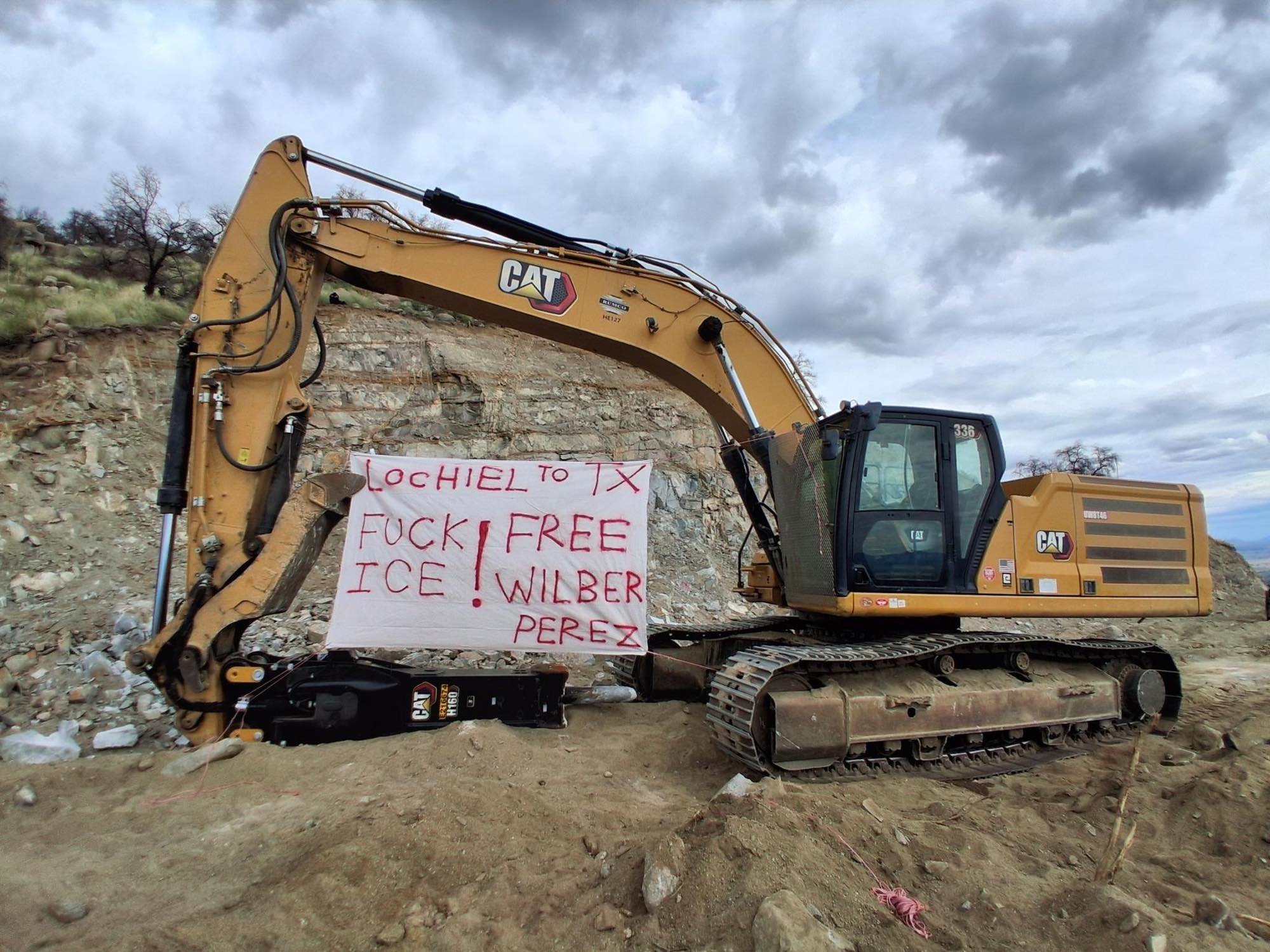
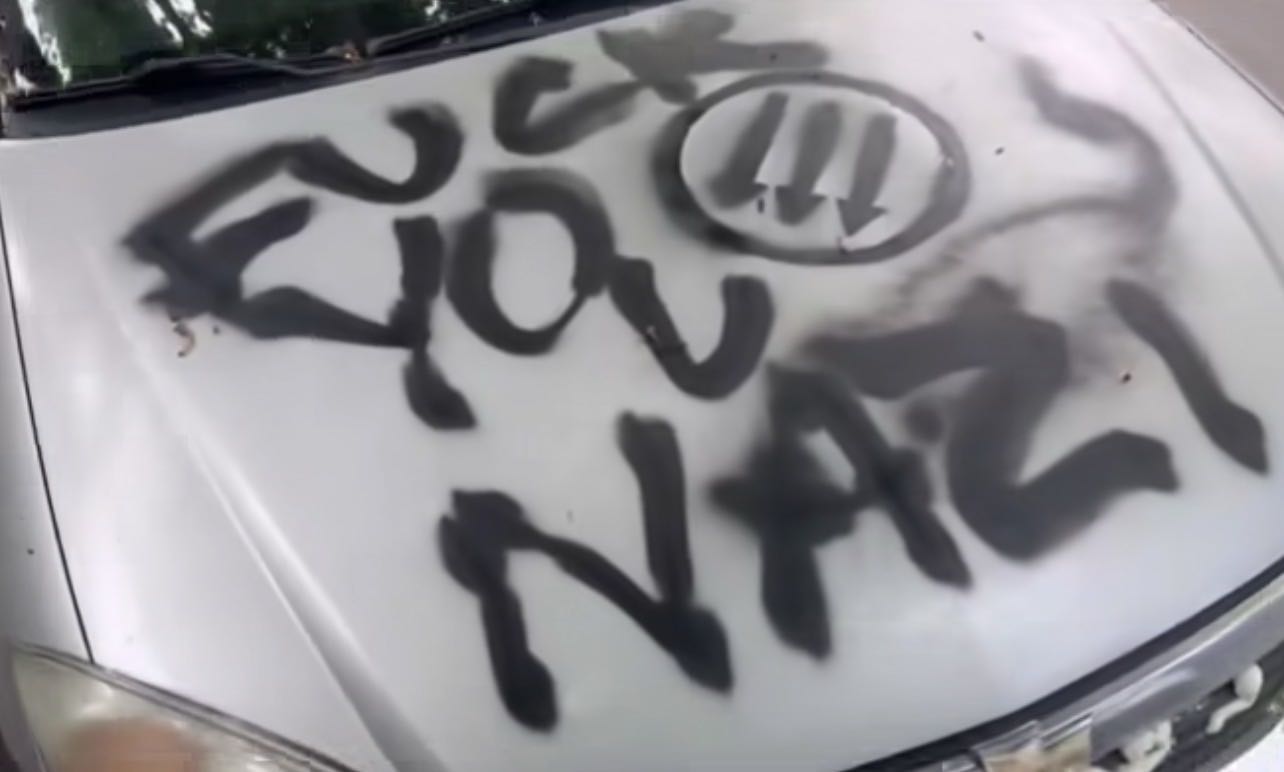
May first proper began when a prominant reactionary, counter-protester, and streamer Tommy Allen, known on the internet as Tommyboi or Tommy4Trump, woke up to find that his car had been vandalized. Tommy Allen walks the line between MAGA and neo-Nazi, sporting apparel connected to European Kindred, a neo-Nazi prison and street gang. A few weeks ago, he was apparently bear-maced after attacking a presentation on the Breaking the ICE: Lessons from the Resistance in Minnesota tour.
That same morning, the local chapter of the Sunrise Movement staged a sit-in blockade at the Hilton-owned Porter Portland hotel in response to their decision to house mercenaries from Immigration and Customs Enforcement, Border Patrol, and other Department of Homeland Security agencies. The sit-in ended when Portland Police arrested eight accused participants. Sunrise Movement PDX also made the news recently for being the first chapter to experience lawfare attacks over their nighttime “Wide Awake” noise demos targeting hotels that house federal agents. It may seem tragic that these young people—who wholeheartedly desire to stop the machine that places profit above life—imagine it is useful to get arrested on purpose, but if we cannot offer points of entry for them to encounter other methods and more critical analysis, then we are partly responsible for the tragedy.
Around noon, a radical community fair got underway at the departure point of the “Workers & Migrants Unite!” march that was scheduled to begin three hours later. Groups like the Industrial Workers of the World and anarchist literature distribution projects spent three hours tabling and talking to interested passersby and demonstrators. The Free Society People’s Library brought their mobile truck and distributed books and pamphlets about abolitionist, communist, and anarchist struggle. There were many liberal and authoritarian socialist groups tabling, as well, but anarchist materials were as popular as ever.
The Workers & Migrants Unite March
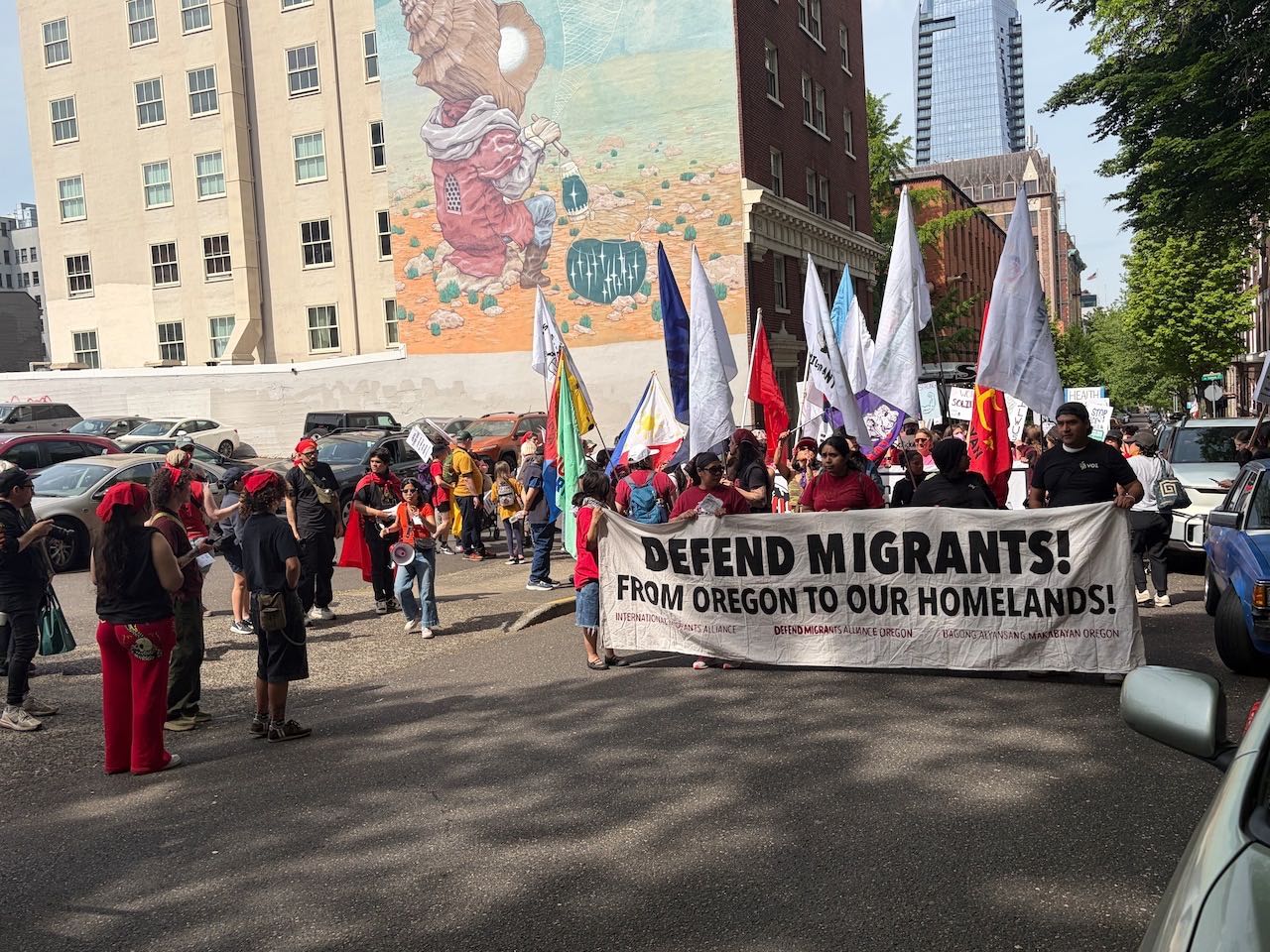
Months ahead of May Day 2026, a loose cluster of anarchists learned that an array of more or less radical organizations were calling for a “Workers & Migrants Unite!” May Day march. The organizers included anarchists, but also the left flanks of unions, anti-deportation groups, and hierarchical political parties ranging from social democrats to niche variants of Stalinism, Trotskism, and Maoism. With so much antagonism already in the air towards capitalism and the state, many surmised that it would worth engaging with the march as a space of encounter. Ever since federal mercenaries attacked the ICE Out of Labor march, opposition to police has been fomenting in rank-and-file unions, anti-deportation front groups, and other circles around Portland.
The organizers of the march explicitly declared that they would not be working with the police and would use the march as an oppurtunity to highlight local sites of capitalist and police-state infrastructure. It looked like a great oppurtunity to spread anarchist ideas and action models and to join forces with other disaffected people. Of course, it was still possible that attacks on capitalist and state infrastructure would be seen as something coming from “outside” the movement, allegedly “giving them [the Trump regime and its supporters] what they want,” and self-appointed or org-deployed peace-enforcers could no doubt be a problem.
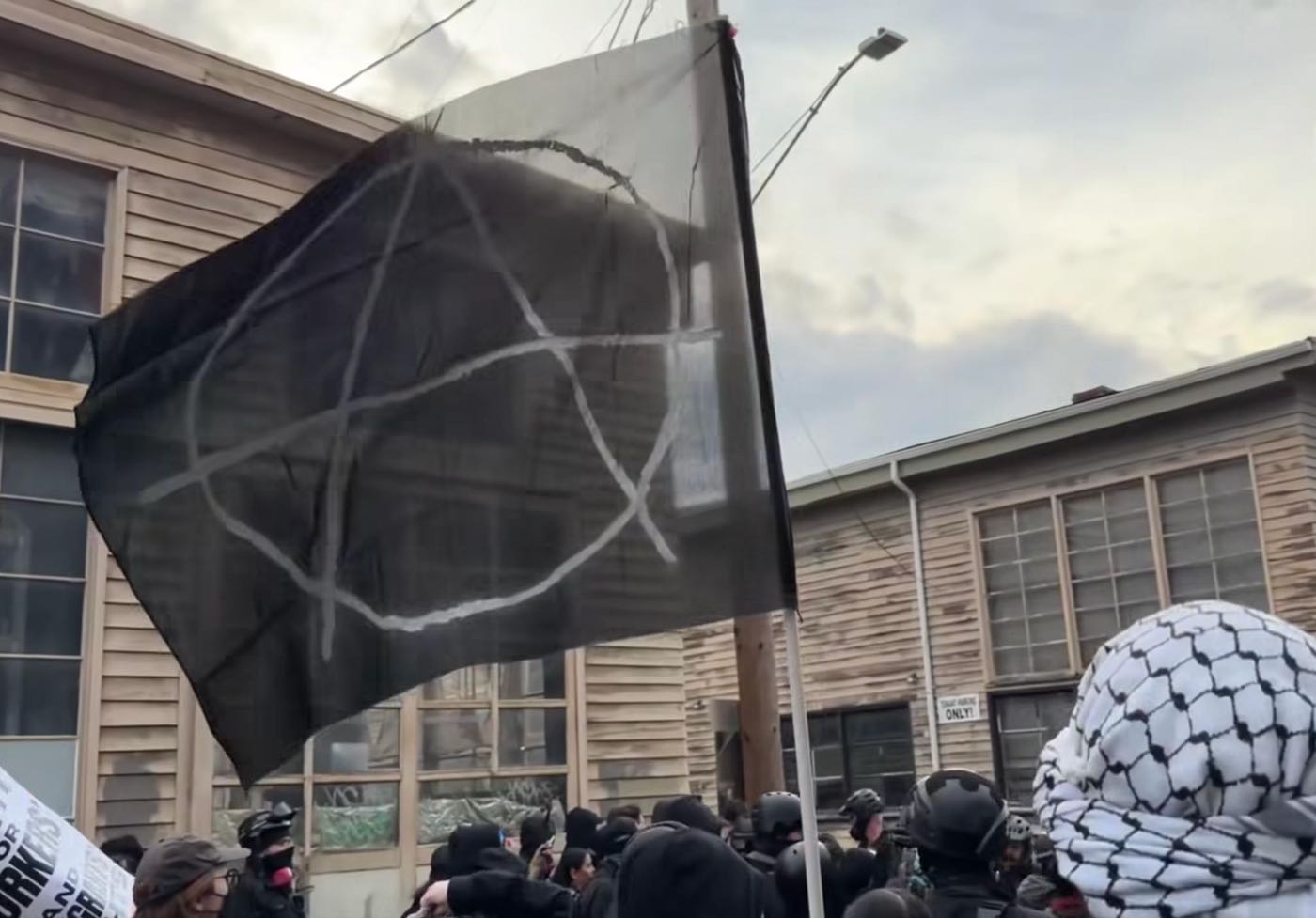
The rough plan to deal with this political terrain was to join the big march as a black bloc with anarchist banners and flags and, at the very least, to give out zines and handbills. If the opportunity arose and the crowd seemed comfortable with it, other activities could take place, as well.
People made banners out of painters cloth decorated with black paint and flags out of black fabric, staples, and dowels. These can be transported in guitar cases if it is important not to attract attention.
After the community fair, anarchists bloc’d up, growing in numbers to about two dozen. One person who had just donned black and a mask and was making their way to the others, was stopped by a passerby, who asked, “Who are you with?”
The question gave the lone anarchist pause. There are many different reasons someone might ask such a thing. Still, they decided to go with honesty. “I’m with the anarchists,” they answered.
The inquirer persisted. “Who’s that?”
“We’re against corporations, capitalism, the police, and government. Oh, and racism.”
“All right, I’m with you.”
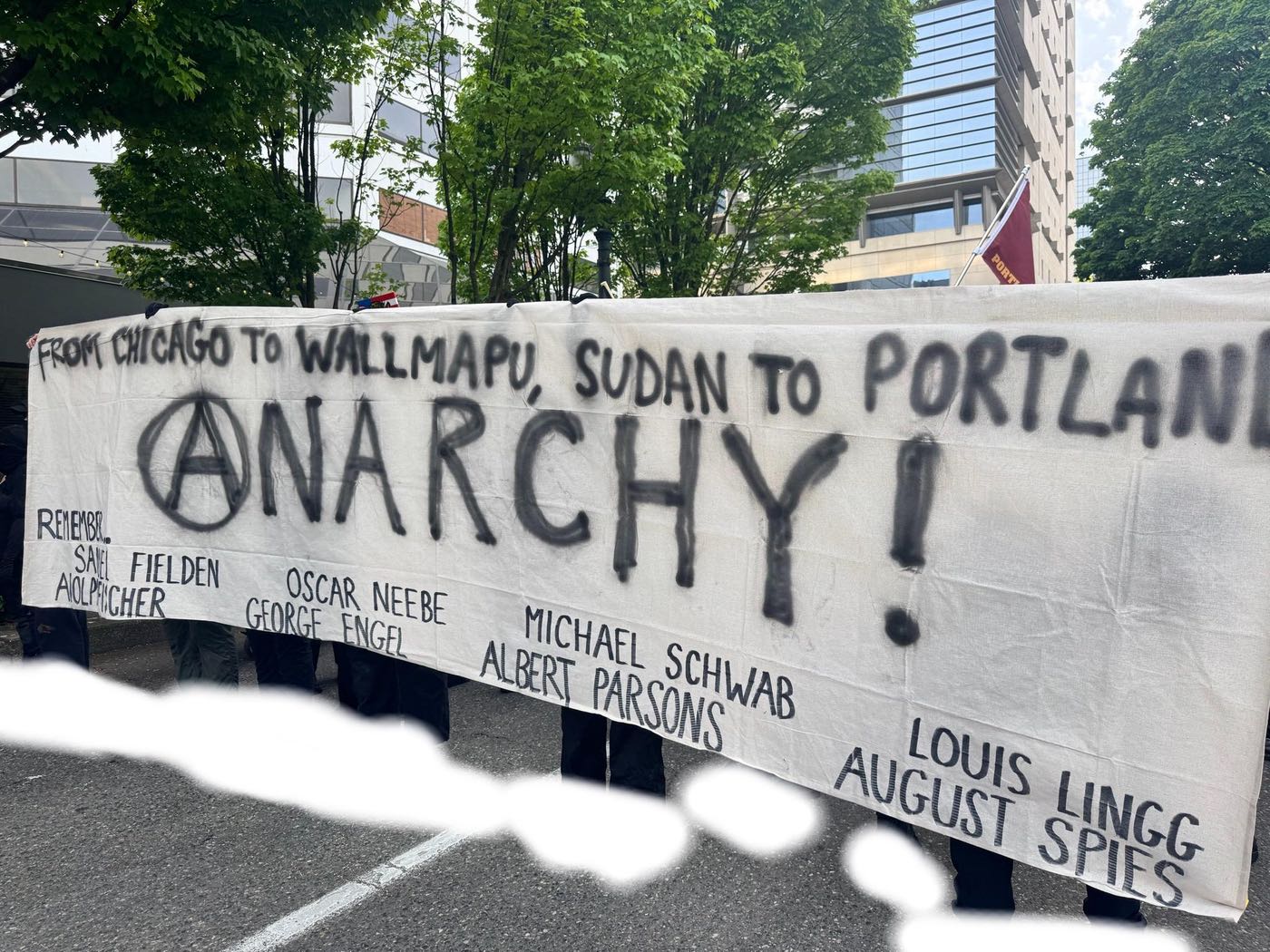
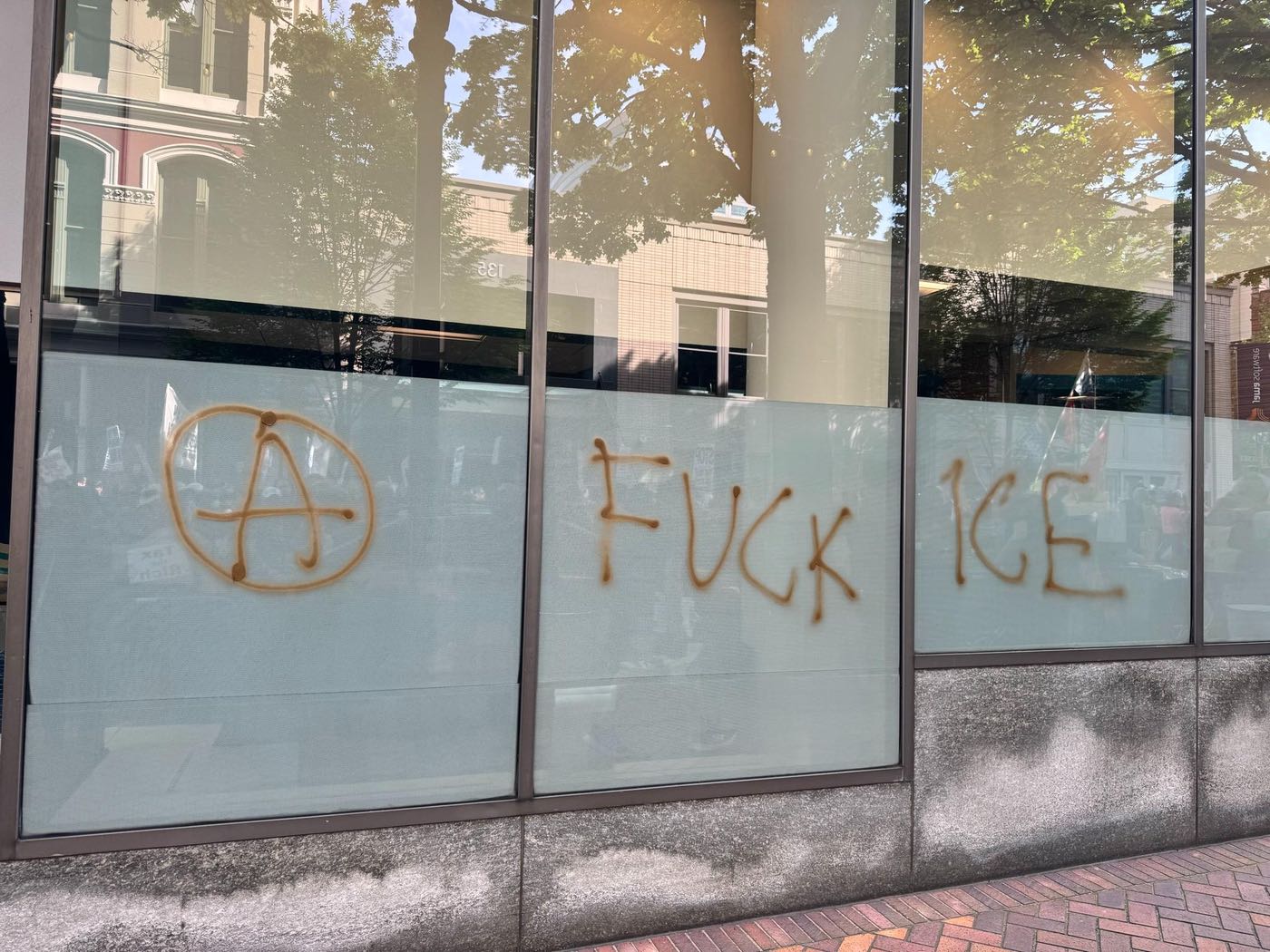
Thousands participated in the march. Anarchists distributed zines and handbills to hundreds of them. About a dozen people made the “thank you for your service” joke, which is also a way for people who attended a march in their normal clothes to flag their support for potential self-defense or direct action. The bloc shouted chants that pushed an insurrectionary and revolutionary position amid the tepid slogans of the surrounding groups, joining the other groups for the more revolutionary chants. Some moved out of the bloc to sabotage parking meters and paint slogans and anarchist symbols. Anarchist graffiti appeared on the Portland World Trade center, which houses the Portland Metro Chamber, a pro-development, pro-cop, and anti-worker group. All of this was met with support from the crowd.
The only person with a problem was an aggresive man filming with his phone who took issue with people sabotaging the meters, despite the fact that parking enforcement in Portland is particularly draconian and largely serves to fund transit cops. This chud was successfully rebuffed, his camera often being blocked by an umbrella. Some speculated that he was a Democrat who believed outlandish theories about anarchists and antifa. He is still a chud, insofar as a chud is anyone who engages in extra-state repression; the term comes from a science fiction movie in which Cannibal Humanoid Underground Dwellers do what the state and capitalists cannot do themselves without dirtying their image. Other more right-wing chuds showed up, but they hid behind the small handful of uniformed cops.
The bloc at this march was less impressive than what we have previously seen on May Day in Portland, but it was undoubtly a success. After the march, the bloc dispersed with no incidents. Some left the streets for the day, while others headed to the starting location of the next demonstration, which would be marching on the infamous ICE Field Office on Macadam Ave.
Between the two marches, Portland State University students occupied a building for a few hours in an attempt to push forward the struggle to fight cuts, obtain better adjunct working conditions, and resist repression of student activists. The students eventually surrendered in response to an overwhelming police presence; thankfully, no one was arrested. Upon leaving the building, students announced, “Nothing is over, we will be back.”
“All out for May Day!” March
The second march of the day was called for by Freedom Road Socialist Organization and the aligned group Portland Contra las Deportaciones. FRSO, for all their faults (which include peace-policing), have been trying to push the struggle against ICE to include actual interventions resisting raids, in contrast to others’ stance in favor of only observing. They have also sought to ensure that the government of the City of Portland’s collaboration and facilitation of ICE doesn’t go unnoticed, routinely organizing home demos at the mayor’s house.
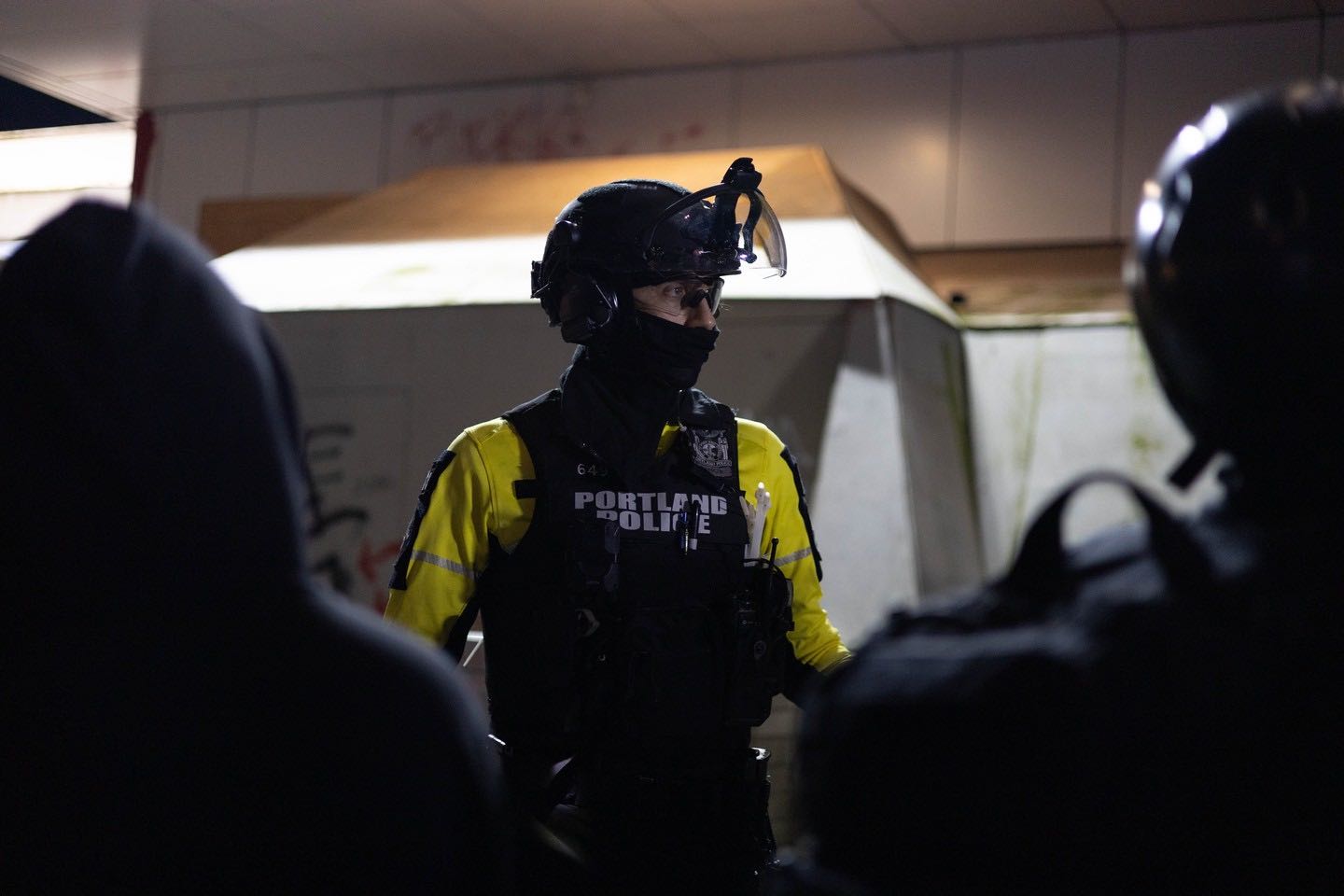
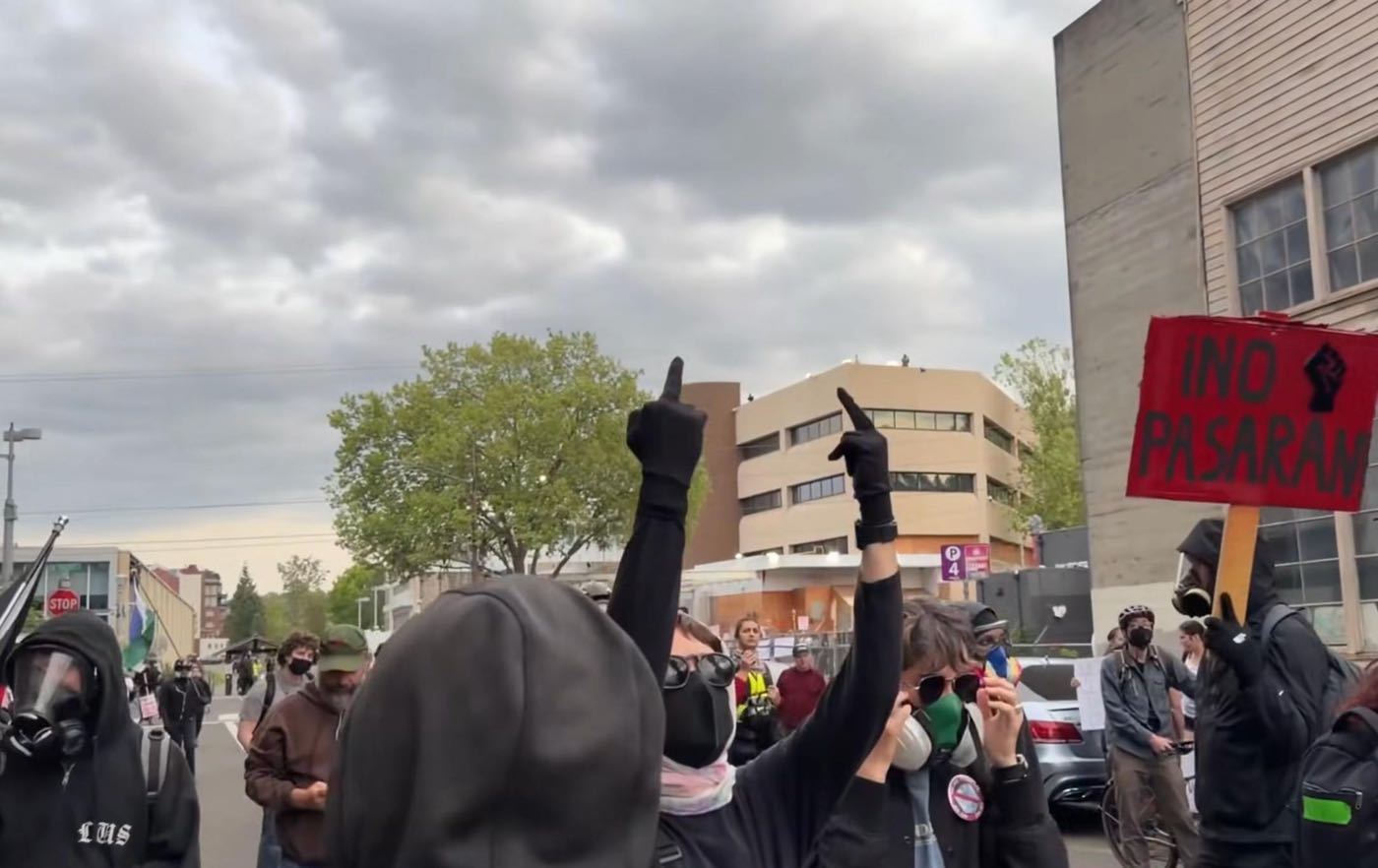
This “All out for May Day!” march to the ICE Field Office and the ensuing siege went pretty much as expected. People gathered in Elizabeth Caruthers Park and made their way to the Field Office; after night fell, there were probably a hundered or so people surrounding the front of the Office with a bloc likely twice the size of the one that attended the earlier march. The only unexpected detail was that the feds switched from using the gated front driveway to using the rear driveway, which is supposed to be for emergencies only. As the night passed, feds from inside the building did survaillance while the the Oregon State Police and the Portland Police Bureau did their dirty work. These local and state cops cleared the driveway with brute force and made several arrests; officers punched people in the head who were already on the ground and engaged in other typical cop activity.
This contrasted with the earlier “Workers & Migrants Unite!” march, at which we had only seen a handful of uniformed cops, with some motorcycle cops tracing the march’s perimeter at a distance of about two blocks, a couple liaison cops positioned to protect chuds or key choke points, and a few plainclothes cops tailing the march. Of the cops in plainclothes, the two that were the most identifiable were Lt. Franz Shoeing and Sgt. Ty Engstrom; they also made their way to the ICE Field Office eventually, where they were accompanied by a third cop in a white hoodie rocking what could only be described as a “copstache.”
The differing police tactics at the two marches illustrates the “good cop” and “bad cop” methods of crowd control. At the first march, where there were more witnesses, the police left the demonstrators to police each other—a strategy that usually works, thanks to march marshals, peacekeepers, and concerned citizens. At the second march, which was rowdier, potentially more actually disruptive to the logistics of the state, but also more out of the way, the police employed violence without restraint in defense of property and their compatriots in the federal forces.
Police violence should come as no surprise. It is more surprising that there was support for confrontation at the big-tent May Day demonstration. This should inform future actions.
And a Car Bombing
On May 2, someone apparently crashed a Nissan Rogue with pipe bombs and propane tanks inside it into the Multnomah Athletic Club in Portland, which caters to a wealthy clientele. This destroyed the club’s first floor, inflicting millions of dollars in damages. The only casualty was the driver, who was found in the flaming wreckage of the car.
This comes on the heels of several related individual expressions of anger and despair, including the Kimberly-Clark Warehouse arson in Ontario, California, the firebombing of the gate of OpenAI CEO Sam Altman’s home, and the attempted attack at the White House Correspondents’ Dinner. Condemning such attacks, to paraphrase Emma Goldman, would be like condemning lightning: so long as tyranny and exploitation exist, there will probably be arsons and bombings and assassinations. This is almost a matter of physics: for every action, there is an equal and opposite reaction. However, to regard these attacks as a sort of memetic path to insurrection misses the point.
An uptick in sporadic attacks does not add up to a viable revolutionary practice. People are taking action because they are desperate, but the problem is that these actions do not make it any easier for other desperate people to act, and they send the message that the inexorable consequence of taking action is defeat and capture or death. Even Luigi Mangione, who carried out the most widely resonant and discursively generative action of this kind in years, was caught. The fact that it took some days for the authorities to catch him contributed significantly to the interest he attracted.
We need to demonstrate that it is possible to take action together, to get away with it, and to act again—to show that action can be a basis for connection and life, rather than a final rejection of hope. We need to demonstrate an affective position and ethic that others can adopt and iterate on. The fact that people are increasingly desperate makes it all the more pressing to send a message to the disaffected—especially those who recognize the limits of conventional protest and the dead ends of electoral politics—that they are not alone, that many other people have reached the same conclusions and feel the same urgency.
The emotional atmosphere of our time has successfully intimidated many people out of acting boldly, confrontationally, and collectively. Near the end of the Biden era, participants in the fight against Cop City in Atlanta wrote that the authorities had sought to “scoop the middle frequencies” out of the movement, creating a gulf between legal public actions and illegal individual actions:
But it is precisely the middle frequencies of a movement that give it its punch—making its rhythms infectious, enabling it to move people and draw them into a process of transformation. Without these frequencies, the results will be muddy and indistinct.
If activists cannot re-assert their right to gather publicly for “mid-range” activities, nocturnal sabotage and civic actions will drift further and further apart, becoming mutually unintelligible and incapable of reaching those outside the movement. Regardless of individual preferences, everyone must recognize the importance of participatory, confrontational activity.
One of the ways we can attempt to reach the disaffected is by going to the beacons intended to draw them in, such as big May Day marches or even “No Kings!” marches. However, this may not succeed in situations where the mechanisms of political capture are already effectively implemented—for example, you’re not going to have an easy time getting proletarians to see things your way at a Trump rally. Likewise, passing out handbills at gas stations, where so many people are being forced to think about economics and geopolitics right now whether they wish to or not, would probably be more effective than trying to court people at a Democrat campaign event.
All in all, it was a great May Day, and it’s only the beginning of something, as many of us are stretching our legs and testing the waters again after a downturn in anarchist activity. Let us heed the advice of Alfredo Bonanno, with whom many anarchists may have unknowningly shared the streets on various May Days, and not abandon intermediate struggles that could mutate in an insurrectionary direction. “Dynamite can explode in the hands of someone who doesn’t know how to use it.” Let us not leave those who are compelled to take a next step in struggle out in the cold without effective techniques or insurgent horizons. Let us demonstrate that there is something effective that we can do together.
Let’s fight for social revolution, in earnest.
Cheers to comrades who took to the streets the world over.
Down with capitalism and the state.
Down with borders, prisons, and police.
Away with any future that still includes exploitation, domination, and class society.
Hurrah for anarchy!